
The Aeschi Working Group
MEETING THE SUICIDAL PERSON
The therapeutic approach to the suicidal patient
PUBLICATIONS
| FUTURE EVENTS |
| NEW: www.assip.ch |
| THE BOOK: BUILDING A THERAPEUTIC ALLIANCE WITH THE SUICIDAL PATIENT |
| THE GUIDELINES FOR CLINICIANS |
| PAST EVENTS |
| 1st Aeschi Conference |
| 2nd Aeschi Conference |
| 3rd Aeschi Conference |
| 4th Aeschi Conference |
| 5th Aeschi Conference |
| 6th Aeschi Conference |
| 7th Aeschi Conference (Aeschi West) |
| 8th Aeschi Conference (Aeschi 8) |
| 9th Aeschi Conference (Aeschi 9) |
| 10th Aeschi Conference (Aeschi 10) |
| PROBLEMS
IN CLINICAL PRACTICE |
| The usual clinical practice |
| Clinicians' attitudes |
| Patients' dissatisfaction |
| Non-attendance in aftercare |
| Treatment failures |
| A PATIENT-ORIENTED APPROACH |
| New perspectives |
| Patients' narratives |
| Patients' inner experiences |
| Joining the patient |
| CAMS |
| The
Narrative Action Theoretical (NAT) approach |
| Mental Pain |
| INFORMATIONS |
| The Aeschi Group |
| Publications |
| Links |
| Sonnenalp Resort |
| Hotel Aeschi Park |
| Destination Aeschi |
| Download main text as pdf here |
| Download Guidelines for Clinicians as pdf here |
| Home |
Valach, L. (2020). Monitoring Problems in Suicide Action. Archives of Depression and Anxiety 6(1): 023-029. DOI:https://dx.doi.org/10.17352/2455-5460.000047
Abstract
Considering suicide in action terms and pointing out that it a distorted action, we describe some of the distortions as problems in self- and action- monitoring. Problems in pain, emotion and awareness as self- and action-monitoring systems were found in suicide actions and projects. We expanded these by the conception of a suicide action in its self-monitoring function. It monitors an inacceptable aggressive thought and action against a relevant other. The conception of suicide as a goal-directed action, on one hand, and the necessity of improving the self- and action-monitoring, on the other, facilitated the development of a brief clinical therapy program in which a reduction of the probability of a suicide attempt by 80% in 24 months was achieved.
Michel, K., Valach, L., Gysin-Maillart, A. (2017). A Novel Therapy for People Who Attempt Suicide and Why We Need New Models of Suicide. Concept Paper. International Journal of Environmental Research and Public Health 14(3), 243; doi:10.3390/ijerph14030243.
Abstract
This paper presents a model of suicidal behaviour based on suicide as a goal-directed
action, and its implications. An action theoretical model has guided the authors in the development
of a brief therapy for individuals who attempt suicide (ASSIP—Attempted Suicide Short Intervention
Program). Key elements are an early therapeutic alliance, narrative interviewing, psychoeducation, a
joint case conceptualization, safety planning, and regular letters over 24 months. In a randomized
controlled trial, ASSIP was highly effective in reducing the risk of suicide reattempts. The therapeutic
elements in this treatment are described and possible implications for future directions in clinical
suicide prevention discussed.
Michel K. Therapeutic Alliance and the Therapist. In: O’Connor R, Pirkis J (Eds.). The International Handbook of Suicide Prevention, Second Edition. John Wiley & Sons, Chichester, 2016, p. 346-361.
Gysin-Maillart, A., Soravia, L., Gemperli, A. & Michel, K. (2016): Suicide Ideation is Related to Therapeutic Alliance in a Brief Therapy for Attempted Suicide, Archives of Suicide Research [Epub ahead of print March 16, 2016], DOI: 10.1080/13811118.2016.1162242.
Abstract
The objective of this study was to investigate the role of therapeutic alliance on suicide ideation as outcome measure in a brief therapy for patients who attempted suicide. Sixty patients received the 3-session therapy supplemented by follow-up contact through regular letters. Therapeutic alliance was measured with the Helping Alliance Questionnaire (HAQ). Outcome at 6 and 12 months was measured with the Beck Scale for Suicide Ideation (BSS). Therapeutic alliance increased from session 1 to session 3. Higher alliance measures correlated with lower suicidal ideation at 12 months follow-up. A history of previous attempts and depression had a negative affect on therapeutic alliance. The results suggest that in the treatment of suicidal patients therapeutic alliance may be a moderating factor for reducing suicide ideation.
Gysin-Maillart, A., Schwab, S., Soravia, L., Megert, M., Michel, K. (2016). A Novel Brief Therapy for Patients Who Attempt Suicide: A 24-months follow-up randomized controlled study of the Attempted Suicide Short Intervention Program (ASSIP). PLOS Medicine 13(3): e1001968. doi:10.1371/journal.pmed.1001968.
Abstract
Background Attempted suicide is the main risk factor for suicide and repeated suicide attempts. However, the evidence for follow-up treatments reducing suicidal behavior in these patients is limited. The objective of the present study was to evaluate the efficacy of the Attempted Suicide Short Intervention Program (ASSIP) in reducing suicidal behavior. ASSIP is a novel brief therapy based on a patient-centered model of suicidal behavior, with an emphasis on early therapeutic alliance.
Methods and Findings Patients who had recently attempted suicide were randomly allocated to treatment as usual (n = 60) or treatment as usual plus ASSIP (n = 60). ASSIP participants received three therapy sessions followed by regular contact through personalized letters over 24 months. Participants considered to be at high risk of suicide were included, 63% were diagnosed with an affective disorder, and 50% had a history of prior suicide attempts. Clinical exclusion criteria were habitual self-harm, serious cognitive impairment, and psychotic disorder. Study participants completed a set of psychosocial and clinical questionnaires every 6 months over a 24-month follow-up period. The study represents a real-world clinical setting at an outpatient clinic of a university hospital of psychiatry. The primary outcome measure was repeat suicide attempts during the 24-month follow-up period. Secondary outcome measures were suicidal ideation, depression, and health-care utilization. Furthermore, effects of prior suicide attempts, depression at baseline, diagnosis, and therapeutic alliance on outcome were investigated. During the 24-month follow-up period, five repeat suicide attempts were recorded in the ASSIP group and 41 attempts in the control group. The rates of participants reattempting suicide at least once were 8.3% (n = 5) and 26.7% (n = 16). ASSIP was associated with an approximately 80% reduced risk of participants making at least one repeat suicide attempt (Wald χ2 1 = 13.1, 95% CI 12.4–13.7, p < 0.001). ASSIP participants spent 72% fewer days in the hospital during follow-up (ASSIP: 29 d; control group: 105 d;W= 94.5, p = 0.038). Higher scores of patient-rated therapeutic alliance in the ASSIP group were associated with a lower rate of repeat suicide attempts. Prior suicide attempts, depression, and a diagnosis of personality disorder at baseline did not significantly affect outcome. Participants with a diagnosis of borderline personality disorder (n = 20) had more previous suicide attempts and a higher number of reattempts. Key study limitations were missing data and dropout rates. Although both were generally low, they increased during follow-up. At 24 months, the group difference in dropout rate was significant: ASSIP, 7% (n = 4); control, 22% (n = 13). A further limitation is that we do not have detailed information of the co-active follow-up treatment apart from participant selfreports every 6 months on the setting and the duration of the co-active treatment.
Conclusions ASSIP, a manual-based brief therapy for patients who have recently attempted suicide, administered in addition to the usual clinical treatment, was efficacious in reducing suicidal behavior in a real-world clinical setting. ASSIP fulfills the need for an easy-to-administer low-cost intervention. Large pragmatic trials will be needed to conclusively establish the efficacy of ASSIP and replicate our findings in other clinical settings.
http://journals.plos.org/plosmedicine/article?id=10.1371/journal.pmed.1001968
Michel K. Will new insights into neural networks help us to improve our models of suicidal behavior? Crisis 2014, 35 (4): 215-218.
Editorial
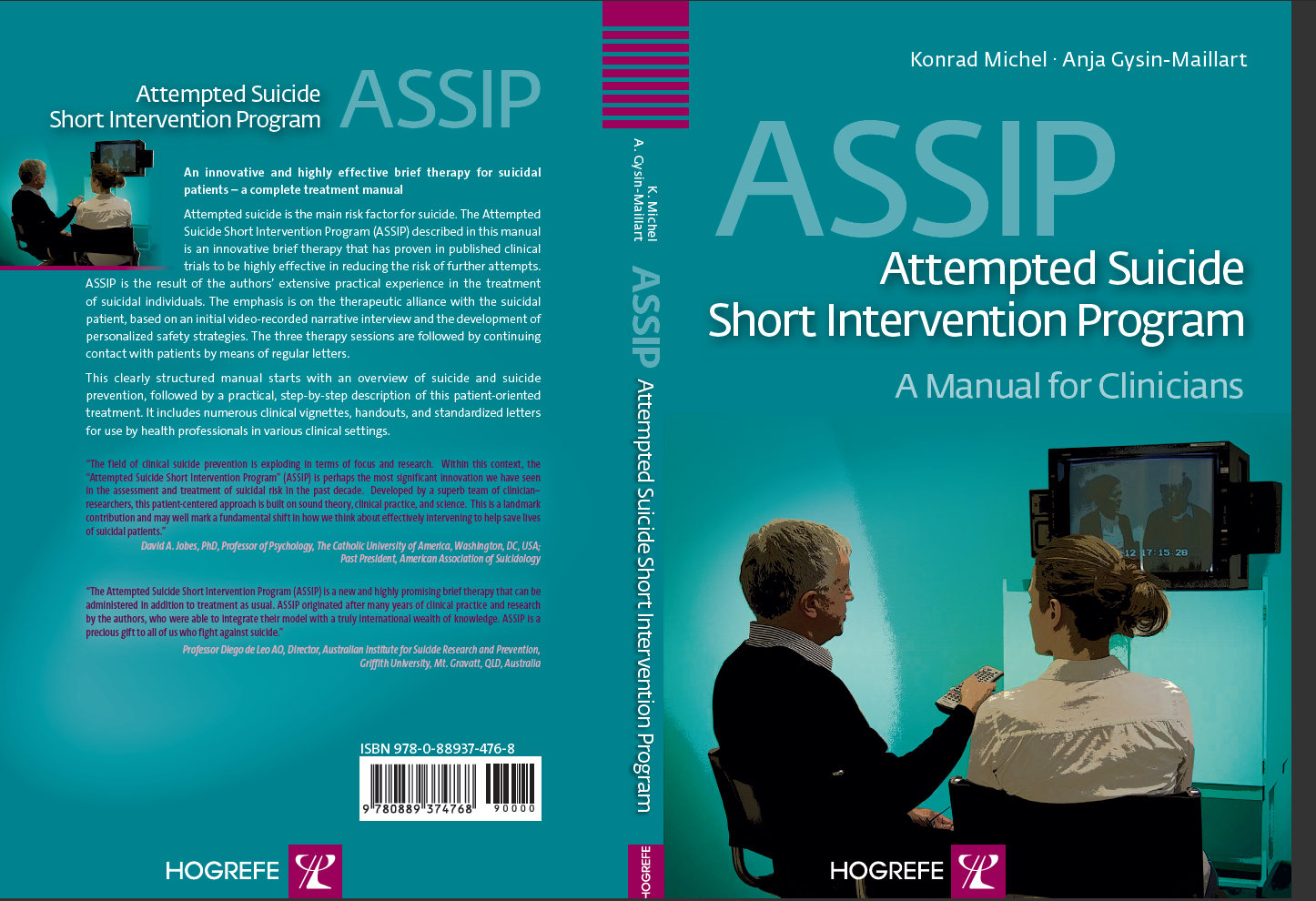
ASSIP – Attempted Suicide Short Intervention Program
A Manual for Clinicians
Konrad Michel & Anja Gysin-Maillart
Hogrefe, 2015
Pages: 114
ISBN: 978-0-88937-476-8
Publication Date: June 2015
An innovative and highly effective brief therapy for suicidal patients – a complete treatment manual
Attempted suicide is the main risk factor for suicide. The Attempted Suicide Short Intervention Program (ASSIP) described in this manual is an innovative brief therapy that has proven in published clinical trials to be highly effective in reducing the risk of further attempts. ASSIP is the result of the authors’ extensive practical experience in the treatment of suicidal individuals. The emphasis is on the therapeutic alliance with the suicidal patient, based on an initial patient-oriented narrative interview. The four therapy sessions are followed by continuing contact with patients by means of regular letters.
This clearly structured manual starts with an overview of suicide and suicide prevention, followed by a practical, step-by-step description of this highly structured treatment. It includes numerous checklists, handouts, and standardized letters for use by health professionals in various clinical settings.
http://www.hogrefe.com/program/assip-attempted-suicide-short-intervention-program.html?catId=121
Indispensible for health professionals faced with suicidal patients
Building a Therapeutic Alliance With the Suicidal Patient
Edited by Konrad Michel, MD and David A. Jobes, PhD, ABPP
Pages: 414
ISBN: 978-1-4338-0907-1
Publication Date: November 2010
Format: Hardcover

For more details look here
Managing
Suicidal Risk
A Collaborative Approach
David A. Jobes, Foreword by Edwin S. Shneidman
Publication Date: August 2006, Guilford Press
This clinical manual offers essential tools and guidance for therapists of any orientation faced with the complex challenges of assessing and treating a suicidal patient. In a large, ready-to-photocopy format, the book provides step-by-step instructions and reproducible forms for evaluating suicidal risk, developing a suicide-specific outpatient treatment plan, and tracking clinical progress and outcomes using documentation that can help to reduce the risk of malpractice liability. In addition to providing a flexible structure for assessment and intervention, The Collaborative Assessment and Management of Suicidality (CAMS) approach is designed to strengthen the therapeutic alliance and increase patient motivation. Highly readable and user-friendly, the volume builds on 15 years of empirically oriented clinical research.
http://www.guilford.com/cgi-bin/cartscript.cgi?page=pr/jobes.htm&dir=pp/paci&cart_id=
Orbach I, Gilboa-Schechtman E, Sheffer A, Meged S, Har-Even D, Stein D: Negative bodily self in suicide attempters. Suicide Life Threat Behav. 2006 Apr;36(2):136-53.
Abstract
In the present study we investigated the relationship between suicidal
behavior and aspects of bodily perception and parental care. Measures
of bodily perception included measures of tactile sensitivity, body attitudes,
and body experiences. Measures of parental care included parental bonding,
negative and positive touch, and early maltreatment. One hundred and two
adolescents (suicidal and nonsuicidal inpatients, and a control group)
participated in the study. It was hypothesized that suicidal adolescents
would (1) have higher tactile sensation thresholds, and more negative
body attitudes and experiences; and (2) report less parental care, lower
positive and higher negative parental touch, and higher parental maltreatment.
It was also hypothesized that bodily sensitivity would mediate the relationship
between suicidal tendencies and perceived negative early care. These hypotheses
were confirmed. The role of a negative bodily self in suicidal behavior
is proposed and discussed.
Orbach I, Mikulincer M, Gilboa-Schechtman E, Sirota P: Mental pain and its relationship to suicidality and life meaning. Suicide Life Threat Behav. 2003 Fall;33(3):231-41.
Abstract
Shneidman (1996) proposed that intense mental pain is related to suicide.
Relatedly, Frankl (1963) argued that the loss of life's meaning is related
to intense mental pain. The first goal of this research was to test Shneidman's
proposition by comparing the mental pain of suicidal and nonsuicidal individuals.
Meaning in life and optimism are the polar opposites of suicidality and
hopelessness, and the examination of these variables in relation to mental
pain was undertaken to provide a test of Frankl's proposition. In two
studies, a relationship between a newly developed measure of mental pain--the
Orbach & Mikulincer Mental Pain Scale, 2002 (OMMP; see also Orbach,
Mikulincer, Sirota & Gilboa-Schechtman, 2002)--and suicidal behavior
and life meaning were examined. Results confirmed both propositions. Implications
for the study of mental pain and suicide are discussed.
Jobes DA and Drozd, JF: The CAMS Approach to Working
with Suicidal Patients. Journal of Contemporary Psychotherapy, Vol. 34,
No. 1, Spring 2004.
Abstract
The Collaborative Assessment and Management of Suicidality (CAMS) is a
novel clinical protocol designed to quickly identify and effectively engage
suicidal outpatients in their own clinical care. The CAMS approach emphasizes
a thorough and collaborative assessment of the patient's suicidality that
then leads to problem-solving treatment planning that is coauthored by
the clinician and the patient. This approach is specifically designed
to launch a strong therapeutic alliance creating an effective treatment
trajectory. The CAMS approach is designed to modify and change clinician
behaviors in terms of how they initially identify, engage, conceptualize,
assess, treatment plan, and manage suicidal outpatients. Critically, however,
CAMS does not usurp clinical judgment or dictate treatment modality. Preliminary
research has shown that CAMS leads to faster resolution of suicidality
and may decrease nonmental health medical utilization. Given the challenges
of clinical work with suicidality, increased concerns about malpractice
liability, and the decreased use of inpatient hospitalization, CAMS provides
a potentially important new approach to working with suicidal individuals
on an outpatient basis. http://springerlink.metapress.com/openurl.asp?genre=article&issn=0022-0116&volume=34&issue=1&spage=73
Antoon A. Leenaars: Psychotherapy with Suicidal
People: A Person-Centred Approach. JOHN WILEY & SONS, LTD, Chichester,
2004.
Suicide is a complex event. There are biological, psychological and sociological influences on suicide and suicidal behavior. Suicide risk is multidetermined. There are so many factors that influence who is at risk and who carries through with suicide. The complexity of suicide calls for an equally complex set of solutions. There is no one solution, but psychotherapy has played a pivotal role in response to these many needless deaths.
Edwin Shneidman, the respected suicidologist, provided the following guidance: ”We ought to know what we are treating.” He believes that we will treat mental health problems, for example, suicide, more effectively, only when we develop a clear and distinct understanding of the suicidal person. ”Our treatment, psychotherapy,” he guides us, ”should address the person’s story.” Our treatment must be person-centered – this is as true in psychotherapy, as medication and hospitalization.
More
http://www.wiley.com/WileyCDA/WileyTitle/productCd-0470863412,descCd-authorInfo.html
Michel K, Dey P, Stadler K, Valach L: Therapist
Sensitivity towards Emotional Life-career Issues and the Working Alliance
with Suicide Attempters. Archives of Suicide Research 2004, 8,203-213.
Abstract
This study investigated the usefulness of an action theoretical model of suicide in interviewing suicide attempters. Eighteen interviews were video-recorded and transcribed. The patients' narratives were reconstructed and life-career issues relevant for the patient's suicidality formulated. Skin conductance reactivity was used to determine narrative content associated with actualized emotions. Scores of the patients' ratings of helping alliance experienced in the interview were positively associated with the therapists' sensitivity towards emotionally relevant life-career issues. Furthermore, relationship satisfaction was related to a narrative interviewing style. We conclude that working alliance in clinical interviews with suicide attempters can be improved when the interviewer uses a patient-oriented approach aimed at understanding the patient's suicidality in the context of personal life-career, or identity issues.
Valach L, Michel K, Young RA, & Dey P: Attempted Suicide Stories: Suicide Career, Suicide Project and Suicide Action. In: Valach L, Young R A Lynam M. J: Action theory. A primer for applied research in the social sciences. CT: Praeger, Westport 2002.
Abstract
Chapter 6 contains a report on a research project dealing with people after a suicide attempt. Using the action theoretical methodology as described in this book and discussing the obtained documents, we argue that suicide processes follow the career-project-action order proposed in the action theoretical conceptualization. Consequently, any professional encounter with people after a suicide attempt can be considered as a part of these goal directed systems. The career-project-action organization is illustrated with two cases obtained in the described project. Some of the issues of this research project were described in more detail elsewhere (Michel, & Valach, 1997).
Valach L, Michel K, Dey P & Young RA: Self-confrontation interview with suicide attempters. Counselling Psychology Quarterly 2002, 15(1), 1-22.
Abstract
Psychiatric and psychological assessment after parasuicide is characterized by a number of difficulties. The interview is a strategically complex task for the patients trying to accommodate the wishes of the psychiatrist/psychologist and their own goals. The psychiatrist/psychologist on the other hand needs to gain information about the event and the patient's mental state, has to assess the risk of further suicidal behaviour, and has to motivate the patient for treatment. In our experience a routine video prompted recall or self confrontation interview, can be a helpful means of talking with the patient about his or her feelings and cognitions during the interview. Furthermore, it allows clarification of the processes leading to parasuicide. The procedure of administering a self confrontation interview is described, the theoretical background for interpreting the results is outlined and some examples of patient interviews are presented. It is demonstrated that this method allows access to additional information on the patients' thinking and emotions during the interview and that it also provides more details of the suicidal process.
Michel K, Dey P, Valach L: Suicide as goal-directed action. In: Understanding Suicidal Behaviour: the Suicidal Process Approach to Research and Treatment (Ed. K. van Heeringen), Wiley & Sons, Chichester, 2001.
Abstract
The generally disappointing results of systematic evaluations of the treatment of suicidal behaviour including the prevention of repeated suicide attempts as described in the previous chapter, indicate the need for a new approach towards the suicidal patient. An obvious prerequisite for establishing a trustful working relationship must be that patient and therapist have a mutual understanding of the reasons for suicidal thoughts or deliberate self-harm. Traditionally, suicidal behaviour has been understood within the frame of the biomedical illness model. This model implies that the health professional has to find the cause of the patient’s pathology and then treat the disorder. However, suicide and attempted suicide both are actions that are planned and carried out by individuals, involving conscious processes, and they are thus not mere signs of illness and pathology. An approach based on action theory may well provide an alternative framework to understand suicidal behaviour and to establish a meaningful communication between health professionals and suicidal patients. Fundamental to this approach is the assumption that a better therapeutic relationship with suicidal patients will help health professionals to become more effective in preventing suicide.
Actions are associated with cognitive and emotional processes, which involve planning, steering, monitoring, and decision-making. Actions are part of mid- and long-term systems consisting of projects and life-career aspects, or life-goals. These processes are influenced by external and internal factors, such as cultural setting, early individual experiences, or psychiatric disorder. Action theory not only provides a model for the study of processes resulting in an action, but it also represents the way we communicate and explain our actions in everyday life, or how we make sense of actions of others.
This chapter will address an action theoretical view of suicidal behaviour by describing, among others, preliminary results of a qualitative study of interviews with suicide attempters. Three aspects can be distinguished. First, suicide attempters in general have an impressive narrative competence. However, to allow patients to develop their narratives, the interviewer must respect the patient as the expert of his or her own actions. This requires a definition of the roles of patient and professional helper that differs from the definition as it is used in the biomedical model. Second, patients understand their suicide action as a part of broader systems, which may include life career aspects and projects, and which are goal-oriented and meaningful to the patient. Suicide thus appears as a (usually temporary) goal, a possible solution, when the accomplishment of long-term goals and projects is seriously threatened. Third, the immediate goal of suicidal action is to escape from an unbearable state of mind and of psychic pain, which may amount to a state of traumatic stress, associated with dissociation, automatisms, and analgesia, due to negative and often humiliating experiences. The suicide action therefore must be understood as an attempt to preserve an individual’s self-respect, or identity.
In action theoretical terms, talking to a suicidal patient is a joint action. In a discourse about the background of a suicidal action, the interviewer becomes the co-author of the patient’s narrative. An action theoretical approach should enable patients and therapists to explore new behavioural strategies in times of emotional crises.
Michel K, Valach L.: Suicide as goal-directed action. Archives of Suicide Research (1997) 3,213-221.
Abstract
There is a crucial difference between the understanding of a person’s action primarily in terms of ”because of” explanations and the understanding in terms of ”in order to”. The ”because of” explanations imply a deterministic and causal view which abandons the autonomy of the patient for responsible actions. The ”in order to” explanation offers a teleonomical view, i.e. an understanding of human action as a goal directed process. Consequently, the approach of a professional helper to his patient will differ in that he will perceive the patient as basically autonomous in so far as he tries to understand the subjective logic for his actions.
An action theoretical approach is based on the assumption that we all have goals that direct actions in our lives. These goals are usually conscious in connection to actions which are related to these goals. In our life-careers we are bound to encounter obstacles and failures in the achievement of these goals. In such critical moments of our life, suicide can appear as a possible solution, a possible alternative goal to our life-goals.
Orbach I: Therapeutic Empathy with the Suicidal Wish: Principles of therapy with Suicidal Individuals. American Journal of Psychotherapy 2001, VOL.55(2), 166-184.
Abstract
Several principles of therapeutic work with suicidal individuals are described. These principles represent different aspects of therapeutic empathy with the suicidal wish. They are based on a theoretical model that presents suicide as an end result of unbearable mental pain. Mental pain is believed to emerge from reciprocal interactions between biochemical imbalances, life stress, personality factors, pain-producing inner patterns (e.g., self-hate, sense of being dispensable), and facilitators and inhibitors of self-destructive behavior. The therapeutic approach is characterized by an empathic experiential encounter with the death wish, the pain-producing inner patterns, self-destructive tendencies, and the exploration of the most dreadful and frightening inner experiences. An empathic attitude toward the wish to die, coupled by an uncompromised confrontation of self-destructiveness, can provide the hope of discovering a path of compromise with life’s difficulties.
Orbach I, Stein D, Shani-Sela M, and Har-Even D: Body Attitudes and Body Experiences in Suicidal Adolescents. Suicide and Life-Threatening Behavior 2001, 31(3), 237-249.
Abstract
The relationships between cognitive and affective attitudes toward the body, body experiences (dissociation, insensitivity, and lack of control), and suicidal tendencies were examined as a derivative of the hypothesis that bodily attitudes and experiences may facilitate suicidal acting out. Three groups of adolescents (aged 14-18), including suicidal (made a suicide attempt) and nonsuicidal inpatients and controls, were compared with regard to suicidal tendencies, various body aspects, and depression and anxiety. A series of MANOVAs, discriminant analysis, Pearson correlations, and regressions were employed. The results show that the suicidal group differed from the two nonsuicidal groups in feelings toward the body, body protection, and body dissociation. Some aspects of bodily measures discriminated between suicidal and nonsuicidal subjects. In addition, various bodily measures were associated with and statistically predicted suicidal tendencies. The discussion focuses on the web of associations between body attitudes and experiences and their role in suicidal behavior.
Jobes, DA: Collaborating to Prevent Suicide: A Clinical-Research Perspective. Suicide and Life-Threatening Behavior 2000, 30, 8-17.
Abstract
It is argued that suicidality is essentially a relational phenomenon; the presence or absence of certain key relationships paradoxically can be both suicide causing and suicide preventive. The relational aspects of suicide are especially poignant in clinical work with suicidal patients. However, when suicidality is involved, there are a number of issues that can interfere with effective clinical practice. Fortunately, a new paradigm has begun to emerge in contemporary clinical suicidology, which objectifies suicidality and emphasizes the phenomenology of suicidal states. Moreover, from an increasingly empirical perspective, this approach is creating new and better ways to effectively assess and treat suicidal conditions.
Valach L, Young RA, & MJ Lynam. Action theory. A primer for applied research in the social sciences. Westport, CT: Praeger 2002.
The following paragraphs are brief quotations from the above book.
Suicide as a System of Goal Directed Action Processes
… we proposed that suicide processes can be interpreted in terms of goal-directed actions (Michel, & Valach, 1996b, 1997). This view is based on assumptions that range from the nature of human beings as autonomous persons socially engaged in goal directed systems to methodological postulates described in previous chapters.
The conceptualization of suicide as a goal-directed and socially and biographically embedded human action helps in understanding the processes that precede suicide and suicide attempts, specifies the dangers of the act of suicide itself, and helps in suicide prevention. Furthermore, an action theoretical understanding of suicide provides the basis for conceiving reliable, theoretically well-grounded, and empirical research on suicide. In applying a framework that incorporates longer-term joint or group action as projects and career, researchers and clinicians can assess the role of others in this process and conceptualize preventive interventions more compatible with the everyday lives of suicide attempters. This approach also underlines the extent of the personal responsibility of others who participate in suicide projects in some way. This perspective shifts one's understanding of the participation of others in a suicide attempt from an element in a causal relation to possibly an actor in a joint action, project or career. As such, these persons can have substantial potential for preventive influence and the promotion of other life projects. Finally, this perspective makes one realize that a suicide is just the last step of action in very differing streams of actions and events.(pp 103-104)
Action Theoretical Conceptualization
Action theory can be seen as a language for use in researching applied tasks that humans engage in their everyday lives (Valach, Young, & Lynam, 1996; Young, Valach, & Collin, 1996). As a theory, it includes, in addition to language, concepts, rules, and prescriptions intended to assist the researcher in accessing human action. Action theory offers concepts distinct from those related to the dynamic of non living objects (Frese, & Sabini, 1985; George, & Johnson, 1985). It is obvious that people use different everyday conceptual language when talking about things than when talking about people. While things lie, stand or are moved around, people rest, wait and intentionally go somewhere. This language is shared among groups of people in their belief systems, is rooted in what has been recently conceptualized as social representation (Farr, & Moscovici, 1984; von Cranach, & Valach, 1983) and is used particularly in the description of action (Heider, 1958, Vallacher, & Wegner, 1987). The term “social representation” implies that using concepts in thinking and describing what people are doing is shared in communities and also is of social origin (Valach, von Cranach, & Kalbermatten, 1988, Valach, 1990/1). As such, these concepts also are a part of the linguistic encoding of cognitive processes (von Cranach, Maechler, & Steiner, 1985). They can be ordered and defined for systematic scientific analysis (Kalbermatten, & Valach, 1985). An action theoretical conceptualization also suggests that this language and these concepts are a part of our planning, steering, controlling and interpreting our own action. This conceptualization addresses issues of context, that is, how actions are embedded in situations. In dealing with human behavior we, as scientists, should utilize and systematize people's everyday conceptualizations about action. By doing so in action theory, it can address the social meaning, manifest behavior, and subjective processes of individuals and groups.(pp 4-5)